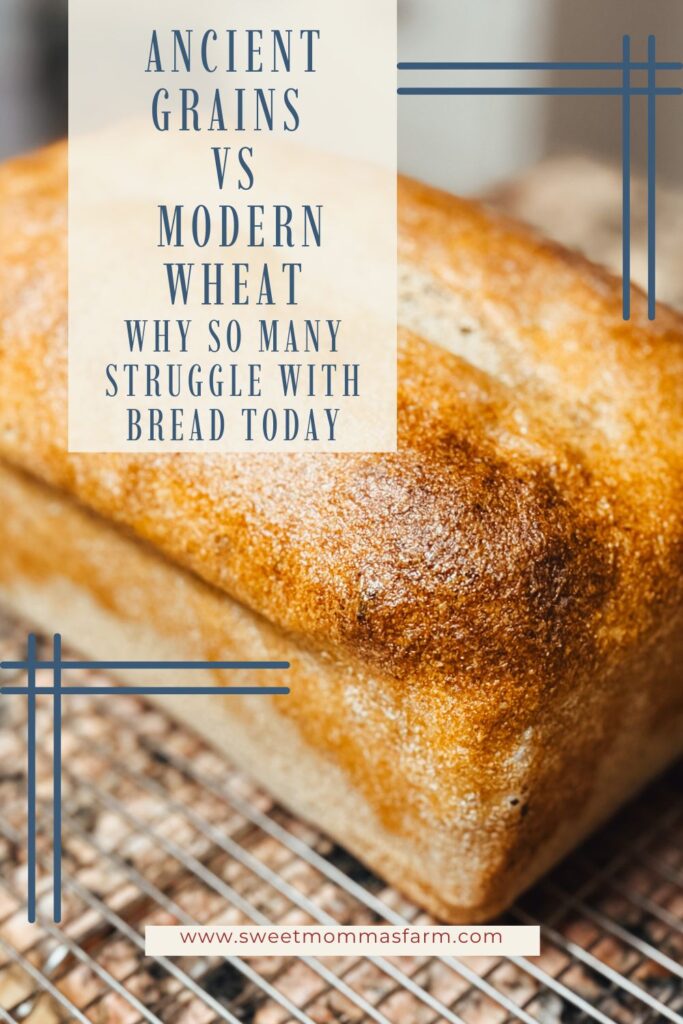
Ancient Grains vs. Modern wheat: Why It Matters for Our Health
Last updated on March 23rd, 2026 at 02:30 pm
Ancient Grains vs Modern Wheat has blown my mind!
Some honesty here—the deeper I go down the rabbit hole of health and food, the more it feels like peeling back layers of half-truths and quiet deceptions. It’s honestly mind-blowing. Every time I think I’ve reached the bottom, there’s another layer waiting.
What I found most recently changed how I look at bread, wheat, and even nourishment itself.
This post isn’t about fear or perfection. It’s about understanding why so many of us struggle with foods our ancestors relied on—and what we can gently return to.
Disclaimer & Terms and Conditions
The Wheat We Eat Today Isn’t the Wheat of the Past
Most of the wheat we consume today—hard red winter wheat, hard red spring wheat, soft red winter wheat, durum, and white wheat (both hard and soft)—has been developed within the last 150 years. In the span of human history, that is incredibly recent.
Modern wheat was bred with good intentions, but very specific goals:
- Higher yields per acre
- Shorter stalks for easier harvesting
- Consistent baking performance
- Lighter, fluffier bread
And while those goals were achieved, there was a trade-off.
Modern wheat has a far more complex gluten structure, higher levels of ATI proteins (amylase-trypsin inhibitors)—proteins known to irritate the gut and trigger inflammation in some people—and increased anti-nutrients. On top of that, this stronger gluten structure requires longer fermentation to break down properly.
Our fast-paced, commercial food system rarely allows for that.
Once I understood this, so many things began to make sense.
Is it really surprising that we’re seeing widespread digestive discomfort, gluten intolerance, blood sugar spikes, and rising rates of celiac disease?
Bread, Faith, and a Hard Question
This discovery led me to ask deeper questions.
Christ calls Himself the Bread of Life. Scripture tells us that God looked at His creation and called it good. Grain—especially wheat—has nourished humanity for thousands of years across cultures and climates.
So why does it feel like bread is suddenly the enemy?
Ezra Taft Benson, who served as U.S. Secretary of Agriculture from 1953–1961, once said:
“What need additional emphasis are the positive aspects—the need for vegetables, fruits, and grains, particularly wheat. In most cases, the closer these can be, when eaten, to their natural state—without overrefinement and processing—the healthier we will be. To a significant degree, we are an overfed and undernourished nation digging an early grave with our teeth.”
That quote stopped me in my tracks.
If grain matters—and Christ used bread as a holy symbol—perhaps the issue isn’t grain itself, but how far we’ve pushed it from its original form.
That question is what led me to ancient grains.
Discovering Ancient Grains
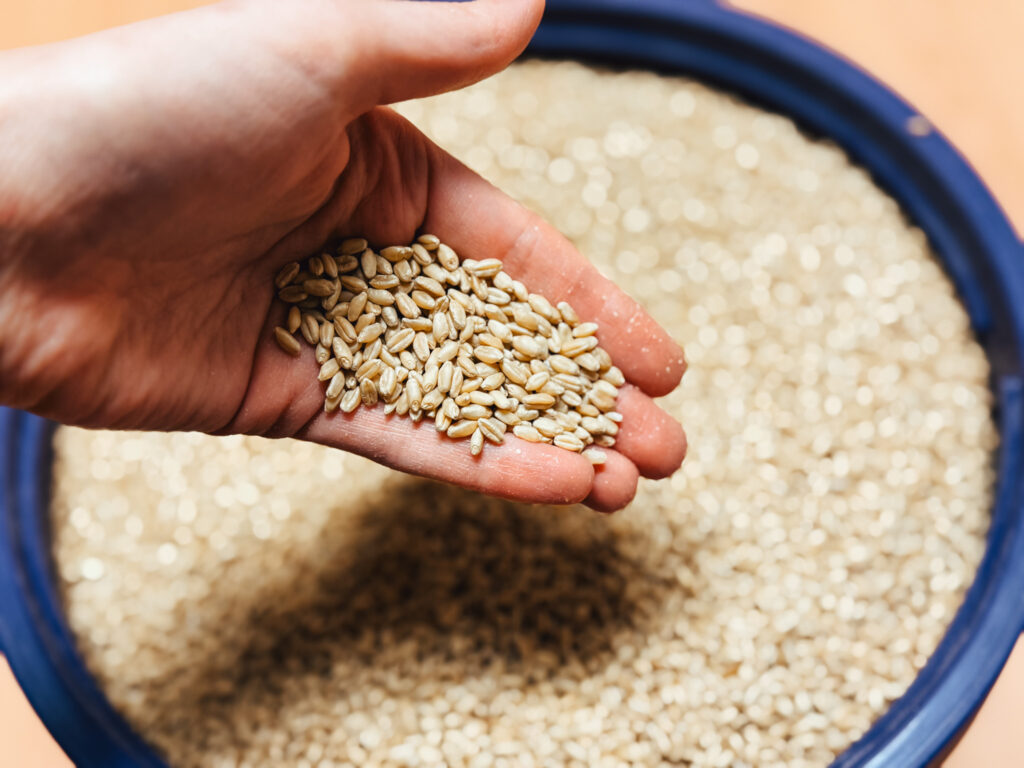
When I say I’m excited about ancient grains, it’s truly an understatement. These are the original grains—the grains our ancestors lived on, and very likely the grains Christ Himself would have been referring to.
Ancient grains have not been hybridized for industrial performance. They haven’t been bred to withstand chemical farming or mass production. They are simple, whole, and unchanged.
And for many people—including our own family—they feel different in the body.
Lighter. Gentler. More nourishing.
This is where things really started to click for me.
Ancient Grains vs. Modern Wheat
Let’s slow down and look at them side by side.
Ancient Grains
Examples: Einkorn, Emmer, Spelt, Khorasan (Kamut)
Genetic Makeup
Ancient grains have much simpler genetics. Einkorn, for example, is a diploid grain with 14 chromosomes, compared to modern wheat, which is hexaploid with 42 chromosomes.
Nutritional Profile
Ancient grains are generally higher in:
- Protein
- Fiber
- Vitamins (such as lutein in einkorn)
- Minerals including iron, magnesium, phosphorus, polyphenols, antioxidants, and essential minerals like selenium that all help with reducing inflammation in the body.
Gluten Structure
Ancient grains still contain gluten, but it is weaker and less complex, which many people find easier to tolerate.
Digestibility
Those with non-celiac gluten sensitivity often report better digestion due to:
- Simpler protein structures
- Lower fructan content (FODMAPs)
- Better compatibility with long fermentation methods like sourdough
Modern Wheat
Examples: Hard red wheat, soft wheat, white wheat (hard and soft), spring wheat, durum
Genetic Makeup
Modern wheat is a highly complex hybrid, bred primarily for yield, uniformity, and baking performance.
Nutritional Profile
It is often lower in certain minerals and micronutrients, with a higher starch content compared to ancient varieties.
Gluten Structure
Stronger, stretchier gluten creates airy bread—but can be much harder on the digestive system.
Digestibility
For sensitive individuals, modern wheat may contribute to:
- Gut pain and bloating
- Blood sugar spikes
- Inflammatory responses
Purpose
Modern wheat was bred for efficiency and profit—not necessarily nourishment.
Who Ancient Grains May Help
Ancient grains are not a cure-all, but they may be a better option for:
- Those with non-celiac gluten sensitivity
- People struggling with digestion after eating modern wheat
- Families interested in traditional, slow-prepared foods
They are not gluten-free and are not safe for those with celiac disease.
A Note on Fermentation
Preparation matters just as much as the grain itself.
Long fermentation—like traditional sourdough—helps break down gluten and anti-nutrients, making grains easier to digest and more nourishing. This slower method is how bread was made for generations, long before commercial yeast and rushed timelines.
It’s another reminder that our bodies were designed for food made with patience.

Key Takeaway
Modern wheat excels in yield and convenience, but ancient grains offer something deeper: nutrition, tradition, and a closer connection to the food God originally gave us.
This journey hasn’t been about restriction for me—it’s been about return. Returning to food that feels honest again. Slower. Older. More rooted.
If you’re curious, start small. Try einkorn. Try sourdough. Pay attention to how your body responds.
Sometimes, going back really is the way forward.





So informative! We love fresh milled!
Beautifully written! I feel inspired to try ancient grains now myself. And I love how you mentioned that what God created is good. That’s so true! Of course he would create grains that are more nourishing and nutrient dense!😊♥️
Thank you so much for sharing this! I’ve not yet tried fresh milled grains but I really really want to soon! I love how much better and more nutritious is it for our bodies.
Yes, fresh milled grains are the best! But look into ancient grains, because they are even better then regular grain.
Ahhhhh I love this. Beautiful post and so important – really life changing. I’m looking at my Einkorn sourdough starter sitting on the kitchen counter right now. It’s the only “gluten” bread my family can eat. Thank you for breaking down the information so clearly!